Speed Comparison: Single-Shot vs Reusable Objects
For a simple case, there are convenience functions (hankrs::one_shot::qdht and iqdht) which can be used to calculate the transform of a function without needing to manually manage a state object.
However, these functions come with heavy internal overhead because they completely re-calculate all of the Bessel roots and transformation matrices on every single call. To demonstrate this overhead, we will use the exact same beam-propagation application as in our Complex Beam Propagation example, and time the difference between generating a state machine once vs relying on one_shot.
Here is the source code:
mod helper;
use hankrs::one_shot::{iqdht, qdht};
use hankrs::{HankelScalar, HankelTransform};
use ndarray::{Array1, Array2, ArrayRef1, Axis};
use num_complex::Complex64;
use std::f64::consts::PI;
use std::time::Instant;

use crate::helper::imagesc;

// Speed of single-shot vs reuse of a HankelTransform object
//
// For a simple case there are two simple forward and inverse functions which can be used to calculate the
// Hankel transform of a function sampled at an arbitrary set of points in radius / wave-number space.
// Here we will use the same example application as the usage_example:
// a beam-propagation method propagation of a radially-symmetric Gaussian beam.
fn propagate_using_object(
    r: &ArrayRef1<f64>,
    field: &ArrayRef1<Complex64>,
    nr: usize,
    nz: usize,
    z: &ArrayRef1<f64>,
    k0: f64,
) -> Array2<f64> {
    let transformer = HankelTransform::new_from_r_grid(0, r.to_owned()).unwrap();
    let field_for_transform = transformer.to_transform_r(field).unwrap(); // Resampled field
    let hankel_transform = transformer.qdht(&field_for_transform, Axis(0));

    let mut propagated_field = Array2::<Complex64>::zeros((nr, nz));
    let kz = transformer
        .kr()
        .mapv(|kr_val| (k0 * k0 - kr_val * kr_val).sqrt());

    for (n, &z_loop) in z.iter().enumerate() {
        let phi_z = kz.mapv(|kz_val| kz_val * z_loop); // Propagation phase
        let hankel_transform_at_z = ndarray::Zip::from(&hankel_transform)
            .and(&phi_z)
            .map_collect(|&ekr, &phi| ekr * Complex64::new(0.0, phi).exp()); // Apply propagation
        let field_at_z = transformer.iqdht(&hankel_transform_at_z, Axis(0)); // iQDHT
        let field_slice = transformer.to_original_r(&field_at_z).unwrap(); // Interpolate output
        propagated_field.column_mut(n).assign(&field_slice);
    }
    propagated_field.mapv(|c| c.norm_sqr())
}

fn propagate_using_single_shot(
    r: &ArrayRef1<f64>,
    field: &ArrayRef1<Complex64>,
    nr: usize,
    nz: usize,
    z: &ArrayRef1<f64>,
    k0: f64,
) -> Array2<f64> {
    let (kr, hankel_transform) = qdht(r.to_owned(), field, 0, Axis(0)).unwrap();

    let mut propagated_field = Array2::<Complex64>::zeros((nr, nz));
    let kz = kr.mapv(|kr_val| (k0 * k0 - kr_val * kr_val).sqrt());

    for (n, &z_loop) in z.iter().enumerate() {
        let phi_z = kz.mapv(|kz_val| kz_val * z_loop);
        let hankel_transform_at_z = ndarray::Zip::from(&hankel_transform)
            .and(&phi_z)
            .map_collect(|&ekr, &phi| ekr * Complex64::new(0.0, phi).exp());
        let (r_transform, field_at_z) =
            iqdht(kr.clone(), &hankel_transform_at_z, 0, Axis(0)).unwrap();

        let field_slice = Complex64::spline(&r_transform, &field_at_z, r, Axis(0));
        propagated_field.column_mut(n).assign(&field_slice);
    }
    propagated_field.mapv(|c| c.norm_sqr())
}

fn main() -> Result<(), Box<dyn std::error::Error>> {
    let nr = 1024;
    let r_max = 5e-3;
    let r = Array1::linspace(0.0, r_max, nr);

    let nz = 100;
    let z_max = 0.1;
    let z = Array1::linspace(0.0, z_max, nz);

    let dr = 100e-6;
    let lambda_ = 488e-9;
    let k0 = 2.0 * PI / lambda_;

    let field_real = helper::gauss1d(&r, 0.0, dr); // Initial field
    let field: Array1<Complex64> = field_real.mapv(|v| Complex64::new(v, 0.0));

    // Now we need two functions that propagate the beam in two ways (giving the same answer).
    // The first will use single shot, the second will use a HankelTransform object.
    // Below we will run each of them in turn and compare the speed.

    // Now run and time the two functions:
    let start = Instant::now();
    let single_shot_intensity = propagate_using_single_shot(&r, &field, nr, nz, &z, k0);
    let duration = start.elapsed();
    println!(
        "Single shot propagation took {:.2?} s",
        duration.as_secs_f64()
    );

    let start = Instant::now();
    let object_intensity = propagate_using_object(&r, &field, nr, nz, &z, k0);
    let duration = start.elapsed();
    println!("Object propagation took {:.2?} s", duration.as_secs_f64());

    // The single shot approach takes a *lot* longer!
    // Plot the two results to check they are the same:

    let z_mm = z.mapv(|val| val * 1e3);
    let r_mm = r.mapv(|val| val * 1e3);

    imagesc(
        "speed_usage_single_shot.png",
        &z_mm,
        &r_mm,
        &single_shot_intensity,
        "Single Shot Output",
        "Propagation distance (z) /mm",
        "Radial position (r) /mm",
        0.0..1.0,
    )?;

    imagesc(
        "speed_usage_object.png",
        &z_mm,
        &r_mm,
        &object_intensity,
        "Object Output",
        "Propagation distance (z) /mm",
        "Radial position (r) /mm",
        0.0..1.0,
    )?;

    Ok(())
}
The Results
If we compile and run this in release mode via cargo run --release --example speed_usage_example, the performance gap is monumental:
Single shot propagation took 2.11 s Object propagation took 0.26 s
The struct-based approach completes in a fraction of a second, yielding roughly a ~50x speedup just by holding onto the HankelTransform struct. When performing multiple identical QDHT operations, it is significantly faster to maintain and reuse HankelTransform objects.
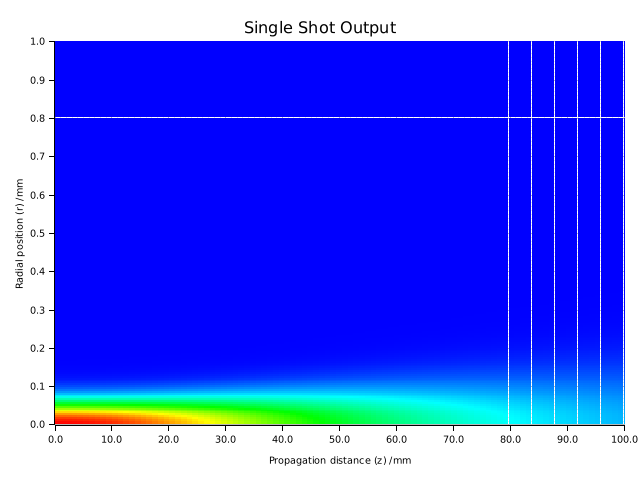
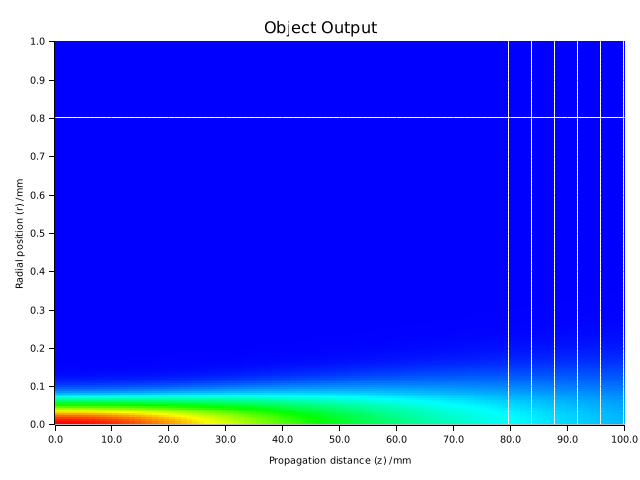
To verify they output exactly the same data, we can plot the resulting beam propagation for both approaches: